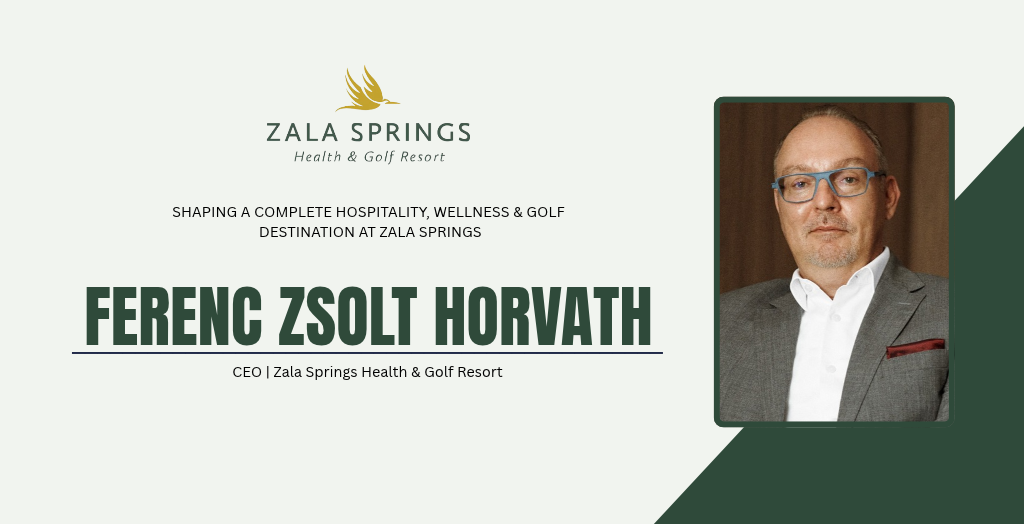
In today’s evolving hospitality landscape, successful resort leadership requires more than operational expertise. It demands the ability to understand changing guest expectations, connect hospitality with wellness and lifestyle, develop strong teams, and create a destination capable of delivering value over the long term. For Ferenc Zsolt Horvath, CEO of Zala Springs Health & Golf Resort, this philosophy has been shaped by an international career spanning hotel openings, resort management, wellness hospitality, golf operations, and executive leadership across Europe, the Middle East, and Central Asia.
Ferenc’s professional journey has taken him through leading hospitality environments associated with Kempinski and Marriott, as well as assignments in Hungary, Jordan, Egypt, Saudi Arabia, Dubai, Kazakhstan, Lithuania, and Albania. Each experience contributed a different perspective to his leadership approach. From opening the Courtyard by Marriott Al Barsha in Dubai and developing local capabilities in Kazakhstan to leading Hotel Európa Fit in Hévíz and managing Vilnius Grand Resort, his career has consistently combined commercial discipline with operational understanding.
Most recently, before joining Zala Springs in September 2025, Ferenc led the pre-opening and opening of Green Coast Hotel, MGallery Collection, in Albania. These diverse experiences have shaped a leadership philosophy grounded in practical observation and accountability. “I look at a property as a guest would, examine its performance as an operator, and consider its future as an owner would,” he explains.
Bringing Diverse Expertise to Zala Springs
The opportunity at Zala Springs represented a natural convergence of Ferenc’s previous experiences in golf resort operations, wellness hospitality, and destination management. Having previously led a major golf resort in Lithuania and a wellness hotel in Hévíz, he saw an opportunity to bring these perspectives together at Zala Springs.
The resort’s 18-hole Robert Trent Jones Jr.-designed golf course, combined with its hospitality facilities, residential offering, and Evergreen Health centre, provides the foundation for a broader destination concept. Ferenc’s vision extends beyond positioning Zala Springs simply as a golf resort. He sees the property as a place where people can enjoy meaningful leisure, wellness, dining, outdoor activities, and the benefits of residential living.
“I want Zala Springs to be somewhere people enjoy living as much as visiting,” he says.
This perspective places real estate development firmly within the resort’s wider hospitality strategy. For Ferenc, purchasing a home at Zala Springs is not simply a property transaction. It is a decision to become part of an environment whose quality, services, and atmosphere must be carefully maintained.
Leadership Built on Accountability
Ferenc describes himself as a hands-on leader who believes strongly in clear ownership and measurable results. When a change is required, responsibilities must be defined, timelines established, and outcomes evaluated.
His background in food and beverage has also kept him close to the operational details that influence guest experiences. Observing breakfast service, speaking with housekeeping teams, and listening to recurring questions from guests can reveal insights that financial reports alone may not capture.
At the executive level, Ferenc also sees his role as maintaining an honest and constructive relationship with ownership. A CEO must understand what the business requires, what investments can realistically achieve, and what the team can deliver.
This approach has been particularly valuable throughout a career involving multiple hotel openings. Construction, recruitment, training, technology, commercial preparation, and operational readiness must all come together before the first guest arrives. His international experience has taught him that a completed building does not necessarily mean a hotel is ready to operate.
The same principle applies to Zala Springs, where today’s operational requirements must be balanced with tomorrow’s development ambitions.
Building the Next Stage of Growth
Ferenc identifies three interconnected strategic priorities for Zala Springs: strengthening the consistency of the existing operation, building demand throughout the year, and defining the next phase of real estate development.
Greater financial visibility across hospitality, golf, food and beverage, and real estate is an important part of this strategy. The resort is working toward more structured reporting, including USALI-based reporting for the hospitality operation, enabling management to identify where value is being created and where additional attention or investment is required.
Commercially, the objective is to create more reasons for guests to visit beyond golf. Wellness, dining, smaller corporate meetings, and experiences connected to Hévíz and Lake Balaton can help support longer stays and increase demand beyond traditional golf periods.
The resort is also exploring a franchise model with a leading international hotel brand, an opportunity that could strengthen its international reach while maintaining the character of Zala Springs.
For future development, Ferenc emphasises careful planning. The right combination of residences, villas, hospitality capacity, and supporting services must be determined by demand, infrastructure, operating requirements, and long-term sustainability.
Creating a More Complete Resort Experience
What distinguishes Zala Springs, according to Ferenc, is the combination of golf, wellness, nature, hospitality, and residential living. Its location in western Hungary, proximity to Hévíz and Lake Balaton, and carefully designed golf environment provide a strong foundation.
The challenge is to ensure that this physical setting is matched by a consistently high-quality experience.
Recent improvements to the resort’s clubhouse demonstrate this philosophy. A comprehensive renovation and expansion has introduced an additional floor, new meeting rooms, a golf simulator room, games rooms, an enhanced lobby and lounge area, as well as refreshed terrace spaces.
A dedicated boardroom provides an intimate environment for exclusive meetings, while a dedicated breakfast setting adds another dimension to the guest experience. Together, these improvements have transformed the clubhouse into a more versatile social and hospitality centre.
For Ferenc, the objective is not simply to add facilities, but to create more reasons for guests, golfers, and homeowners to spend time at the resort.
Understanding the Individual Guest
Personalization is becoming increasingly important as resort guests arrive with different expectations and purposes. A golfer may structure a stay around tee times, while a partner may prioritize wellness and relaxation. Families require flexibility, while homeowners expect dependable services as part of everyday life.
Ferenc believes these differences should influence the way resort services are organized. Dining, activities, appointments, and guest information should work together rather than requiring guests to coordinate every detail themselves.
His focus on the residential experience has also led to greater attention to owner relations, including the development of a dedicated role to ensure that concerns reach the right team and receive appropriate follow-up.
This reflects a broader philosophy: the relationship between a resort and its homeowners continues long after a booking or property purchase. Communication, maintenance, access to services, and a sense of belonging are all essential to creating a successful residential destination.
Technology with a Practical Purpose
Ferenc sees digital technology and artificial intelligence as valuable tools, particularly in management information, forecasting, demand analysis, feedback analysis, and reducing administrative workload.
However, he believes technology must be supported by reliable underlying information. Sophisticated tools cannot compensate for inconsistent data.
For guests, the most valuable digital improvements may be relatively simple: easier check-in, clearer booking information, and more convenient appointment management. The ultimate objective is to allow employees to spend more time interacting with guests rather than managing unnecessary administration.
Guest feedback remains equally important. Ferenc looks beyond numerical satisfaction scores to understand the operational issues behind individual comments. Whether the subject is dining, wellness, course conditions, facilities, or service, feedback can help identify where improvements will have the greatest impact.
People, Sustainability and Long-Term Value
For Ferenc, organizational culture is built through everyday behaviour. Employees observe how managers respond to pressure, complaints, mistakes, and successes. Consistency therefore becomes an important leadership responsibility.
He also believes departments must understand how closely their work is connected. Golf arrangements can influence dining schedules, early arrivals affect housekeeping and reception, and maintenance issues can influence both hotel guests and homeowners.
Sustainability is similarly connected to the long-term vision. The landscape itself is an important part of Zala Springs’ appeal, making responsible development essential. Solar energy is already used across the buildings on the Zala Springs estate, while energy and water consumption, equipment maintenance, and future investment decisions remain important considerations.
Future development must therefore protect not only the environment but also the long-term quality and operational viability of the destination.
A Vision for the Future
Looking ahead, Ferenc envisions Zala Springs becoming a recognized Central European destination where people enjoy staying, dining, playing golf, looking after their wellbeing, and living.
Golf will remain central to the resort’s identity, while wellness, hospitality, and residential development will create a broader lifestyle experience around it.
His vision ultimately goes beyond buildings and facilities. It is about creating a place that works every day: attractive surroundings, quality dining, meaningful leisure opportunities, reliable services, and a team that understands its guests and homeowners.
After a career spent opening and leading hospitality businesses across different countries, Ferenc sees Zala Springs as an opportunity to bring those experiences together in Hungary.
For him, the strongest measure of success will be a financially sound resort, a capable and engaged team, thoughtful development, and satisfied guests and homeowners who continue choosing Zala Springs.
The most meaningful legacy, perhaps, is simple: creating a destination people genuinely want to return to and a place they are proud to call home.