In today’s evolving legal landscape, the role of a Chief Revenue Officer extends far beyond financial oversight. It requires strategic vision, operational discipline, and an unwavering commitment to client outcomes. The most effective revenue leaders understand that sustainable growth is not achieved simply by increasing numbers; it is built through systems that consistently deliver results, align teams around common objectives, and create lasting value.
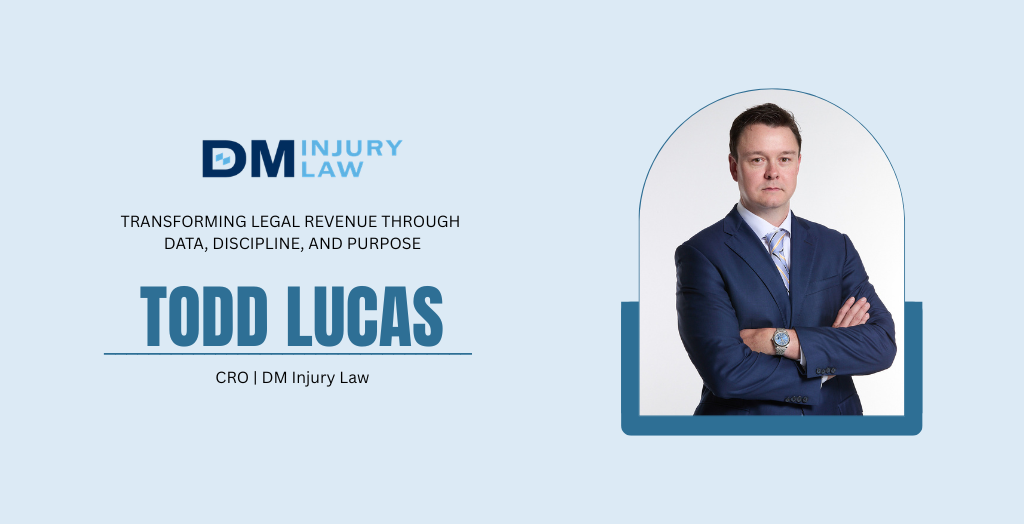
Few leaders embody this philosophy more naturally than Todd Lucas, Chief Revenue Officer at DM Injury Law. With a professional journey spanning finance, public service, legal practice, and executive leadership, Todd has developed a distinctive perspective on what truly drives organizational success. Through data-driven decision-making, process improvement, and a people-first mindset, he has helped shape a growth model rooted not only in performance, but also in purpose.
A Journey Defined by Curiosity and Growth
Todd Lucas never planned to become a Chief Revenue Officer. “I didn’t set out to be a CRO,” he says. “I didn’t even know what that meant early on.” After studying finance at the University of Missouri, his natural affinity for numbers and analytical thinking led him to law school. He began his career as an Assistant Attorney General before joining DM Injury Law as one of the firm’s earliest attorneys.
Initially, his focus was simple: helping people through plaintiff advocacy. However, as his legal career progressed, he became increasingly curious about why certain cases consistently produced stronger outcomes than others. He noticed that factors such as communication, timing, and process efficiency often had a significant impact on results. Rather than accepting those differences as inevitable, Todd began exploring the reasons behind them.
That curiosity gradually evolved into a passion for improving organizational performance. By identifying patterns and examining inefficiencies, he discovered opportunities to create consistency across teams and improve outcomes at scale. What started as an interest in case performance ultimately became a broader commitment to building systems that empower people and deliver measurable results.
Building Growth Through Operational Excellence
Todd originally joined DM Injury Law because he wanted to practice law in a way that genuinely impacted people’s lives. “I didn’t want big law,” he explains. “I wanted to actually help people.” That purpose remains central to his leadership philosophy today.
What has kept him committed to the organization is its willingness to evolve. In Todd’s experience, many firms talk about growth while continuing to rely on outdated systems and familiar routines. DM Injury Law has distinguished itself by challenging conventional thinking and remaining open to improvement.
When he stepped into the role of Chief Revenue Officer, his focus wasn’t on reinventing the business. Instead, he prioritized obtaining reliable data, aligning teams around shared metrics, identifying bottlenecks, and improving the processes slowing cases down. “Once you can see what’s actually happening,” Todd says, “most of the decisions get easier.” This practical approach has strengthened operational efficiency while preserving the firm’s client-centered culture.
Redefining Revenue in Legal Services
Revenue generation within the legal industry differs significantly from traditional business environments. Unlike organizations that recognize revenue immediately following a sale, law firms often navigate timelines extending months or even years. This reality requires a fundamentally different perspective on growth.
For Todd, revenue is not simply about attracting leads or increasing conversion rates. It encompasses the entire client journey—from selecting the right cases and managing them effectively to ensuring timely execution and favorable outcomes. “You’re not selling something and getting paid next week,” he notes. “A lot of firms ignore everything after intake. That’s where most of the money is won or lost.”
By examining the complete lifecycle of a case, Todd has helped DM Injury Law establish a more comprehensive approach to revenue leadership. Rather than focusing exclusively on the front end of the funnel, the firm emphasizes quality, consistency, and execution throughout every stage of the process.
Creating Alignment Across the Organization
One of Todd’s defining strengths is his ability to unite teams around shared objectives. In many organizations, departments operate independently, measuring success through isolated metrics and competing priorities. Todd believes sustainable growth requires a different approach.
At DM Injury Law, marketing, intake, legal operations, and client experience all contribute to the same outcome. Marketing focuses on attracting qualified opportunities, intake prioritizes converting the right cases, legal teams emphasize delivering strong results efficiently, and client experience initiatives strengthen trust and generate referrals.
Rather than evaluating these functions separately, the firm tracks performance collectively. “If something’s off, we don’t argue about it—we can see it,” Todd explains. This transparency creates accountability, reduces friction, and ensures that everyone understands how their contributions support the organization’s broader mission.
Systems, Data, and Ethical Leadership
While culture matters deeply, Todd believes systems transform values into consistent action. Attorneys at DM Injury Law are encouraged to approach every case as though they were representing a member of their own family. “It sounds simple,” he says, “but it changes how people work.”
However, good intentions alone cannot sustain excellence. The firm has invested heavily in building processes that make high performance repeatable. Performance tracking, standardized procedures, and clearly defined expectations ensure that quality becomes an organizational standard rather than an occasional achievement. “It’s less about doing more,” Todd explains. “It’s more about doing things better.”
Data serves as the foundation of this philosophy. Todd and his team continually analyze where cases originate, how they progress, how long they remain active, and where inefficiencies emerge. Metrics such as cost per case, conversion rates, case timelines, and attorney outcomes provide valuable insight into performance. Importantly, these insights are shared throughout the organization, empowering individuals and supporting better decision-making at every level.
Equally important is maintaining trust. “We don’t try to balance it,” Todd says. “The client comes first.” If a decision benefits revenue but compromises client interests, it simply isn’t pursued. Long-term growth depends upon credibility, reputation, and consistently prioritizing those who place their trust in the firm.
Technology, Teams, and the Future of Growth
Technology continues to reshape the legal industry, but Todd approaches innovation with practicality rather than hype. Digital marketing remains an important component of the firm’s strategy, yet he emphasizes that increased spending alone cannot guarantee results. Lead quality, intake effectiveness, and operational readiness must work together.
Automation helps eliminate repetitive tasks and allows attorneys to focus on delivering stronger outcomes. Artificial intelligence also presents opportunities, although Todd remains realistic about its capabilities. “AI is part of that,” he says, “but it’s not magic. If your process is bad, AI just speeds up a bad process.” For technology to create meaningful value, it must strengthen effective systems rather than compensate for ineffective ones.
The same principle applies to leadership. Todd believes people perform best when expectations are clear. Employees need to understand what they’re responsible for, how success is measured, and what outcomes matter most. “Most high performers don’t need much motivation,” he says. “They want to win.” Looking ahead, he believes firms that embrace data, technology, and operational discipline will continue to pull ahead. For DM Injury Law, growth opportunities remain significant, provided quality remains uncompromised.
Advice for the Next Generation of CROs
For aspiring Chief Revenue Officers, Todd offers advice rooted in resilience and continuous improvement. “Don’t be afraid to make mistakes,” he says. “Do be afraid of being mediocre.”
Every leader will encounter setbacks, miss goals, and make decisions that don’t produce the desired outcome. What distinguishes successful leaders is their willingness to learn from those experiences and use them as motivation to improve. Progress, not perfection, drives long-term success.
Conclusion
Todd Lucas represents a new generation of revenue leaders—professionals who understand that sustainable growth is built through discipline, transparency, ethical leadership, and an unwavering commitment to people. By combining legal expertise with analytical rigor and operational excellence, he has helped redefine what effective revenue leadership looks like within the legal services industry.
As organizations navigate increasingly complex environments, leaders like Todd remind us that exceptional results are rarely accidental. They are achieved through aligned teams, thoughtful systems, client-first decision-making, and a relentless pursuit of improvement. For Todd Lucas, revenue leadership isn’t simply about growing the business—it’s about creating lasting value for clients, empowering people to perform at their best, and building organizations designed to thrive for years to come.