
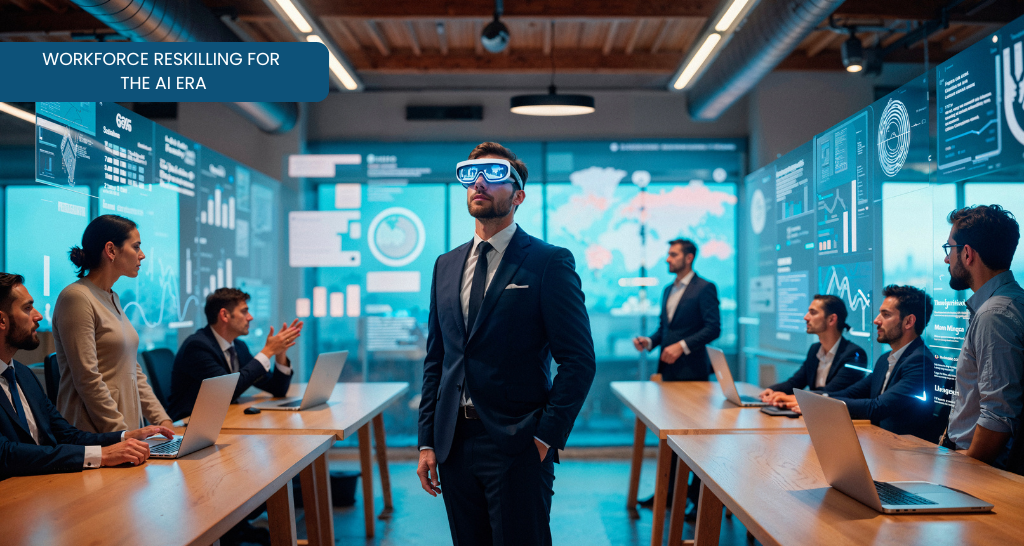
Introduction to Workforce Reskilling
As artificial intelligence (AI) continues to advance and integrate into various sectors, the concept of workforce reskilling emerges as a critical response to this technological evolution. Workforce reskilling refers to the process of training employees to acquire new skills or to enhance their existing skills in order to remain relevant and competent in an ever-changing job landscape. With AI increasingly automating tasks and altering job responsibilities, the need for reskilling becomes more apparent for both employees and employers.
The integration of AI technologies across industries is reshaping the way work is performed. Job roles that once relied on manual tasks are now being transformed by AI-driven solutions, resulting in significant shifts in the demand for specific skill sets. Consequently, many workers face a personal imperative to adapt to these changes, ensuring they remain employable in a market characterized by rapid technological advancement. This urgency is not just a matter of personal career development; it also poses a collective challenge for organizations aiming to retain a skilled workforce.
The challenges posed by AI in the labor market cannot be understated. As businesses leverage AI to enhance productivity and efficiency, they may inadvertently render certain job functions obsolete. However, this displacement also brings about new roles that require a different set of competencies, driving the need for reskilling initiatives. Organizations are increasingly recognizing their responsibility to facilitate this transition, embracing programs that offer training and development to equip their employees with the necessary skills to thrive alongside AI technologies.
In this context, workforce reskilling becomes not only a strategic business initiative but also a necessary response to the shifts in the job market resulting from AI transformations. Addressing these reskilling needs ensures that the workforce is not only prepared for the AI era but also poised to harness the potential of these technologies for growth and innovation.
The Impact of AI on Job Markets
The integration of artificial intelligence (AI) into various industries is profoundly transforming job markets globally. As sectors increasingly adopt AI technologies, the demand for certain skills is evolving, leading to both job displacement and the emergence of new employment opportunities.
One significant impact of AI is the automation of jobs that involve routine tasks. For instance, manufacturing roles, data entry positions, and administrative jobs are at a higher risk of being replaced by machines and algorithms. According to a report by the McKinsey Global Institute, nearly 800 million jobs worldwide could be displaced by automation by 2030, representing about 30% of the global workforce. Such statistics underline the urgency for workforce reskilling, enabling workers to transition into new roles that require advanced skills and creativity.
Conversely, AI technology is also creating new job opportunities that did not exist before. For example, there is a growing demand for AI specialists, data analysts, and ethical compliance officers. These emerging positions require a blend of technical expertise and critical thinking skills, reinforcing the need for ongoing education and training. According to the World Economic Forum, by 2025, it is expected that 97 million new roles will emerge that are more adapted to the new division of labor between humans and machines.
Experts suggest that reskilling initiatives are essential not only for improving individual career prospects but also for maintaining economic stability in a rapidly evolving job market. Companies and governments are increasingly recognizing the importance of investing in training programs to help workers adapt to the changes driven by AI.
Key Skills Required in the AI Era
The advent of artificial intelligence (AI) has significantly transformed the job landscape, necessitating a shift in the skills that workforce members must cultivate. As AI systems become increasingly integrated into various industries, both technical and soft skills are essential for employees seeking to thrive in this new environment.
Among the technical skills, data analysis has emerged as a crucial competency. The ability to interpret and manipulate data allows workers to extract valuable insights that can inform decision-making processes. Furthermore, knowledge of machine learning techniques helps individuals to understand how AI systems operate, enabling seamless team integration with these technologies. Understanding programming languages associated with AI, such as Python or R, can also enhance a worker’s effectiveness in a technologically advanced workplace.
In addition to technical skills, soft skills play a vital role in ensuring successful collaboration between human workers and AI systems. Creativity is becoming increasingly important, as it allows employees to innovate and develop novel solutions that machines may not be capable of generating. Emotional intelligence is another critical asset, as it enhances interpersonal communication and strengthens teamwork, facilitating a harmonious working relationship in a diverse environment shaped by AI. Being adaptive and open to change is equally essential; as the pace of technological evolution accelerates, the workforce must embrace continuous learning and skill enhancement.
Ultimately, the skills required in the AI era extend beyond mere technical know-how. For workers to excel, an amalgamation of technical prowess and well-honed soft skills is necessary, fostering a collaborative spirit between humanity and artificial intelligence.
Strategies for Effective Reskilling Programs
As organizations navigate the challenges posed by advancements in artificial intelligence, implementing effective workforce reskilling programs becomes imperative. One of the core strategies involves creating a culture of continuous learning within the organization. Employers should provide employees with clear pathways for skill advancement, ensuring they understand how reskilling aligns with their career aspirations. This approach not only boosts morale but also encourages a proactive approach to skill development.
Another significant strategy is forming partnerships with educational institutions. Collaborating with universities and training providers can offer employees access to specialized training programs and resources that may not be available internally. These partnerships can facilitate tailored training modules that address specific industry needs, equipping employees with relevant skills necessary to thrive in an AI-driven landscape.
Moreover, leveraging online platforms for skill development is crucial in the modern workforce. Technology has enabled organizations to provide flexible and accessible training options, allowing employees to learn at their own pace. Online courses, webinars, and virtual workshops can be integrated into the reskilling strategy, catering to diverse learning styles and preferences. This flexibility is particularly valuable for employees balancing work and personal commitments.
Additionally, the effectiveness of mentorship and on-the-job training should not be overlooked. Establishing mentoring programs allows less experienced employees to learn directly from seasoned professionals, fostering knowledge transfer and practical skill application. On-the-job training promotes experiential learning, enabling employees to develop competencies while contributing to the organization’s productivity.
In conclusion, a multi-faceted approach encompassing a culture of learning, strategic partnerships, online resources, and mentorship can significantly enhance the efficacy of workforce reskilling programs, ultimately preparing organizations for the AI era.
The Role of Government in Reskilling Initiatives
Governments across the globe are increasingly recognizing their critical role in facilitating workforce reskilling in the face of the rapid advancement of artificial intelligence (AI). As technological disruptions transform job landscapes, it is vital for public sector entities to implement comprehensive strategies that support workers in acquiring new skills and enhancing their employability. Central to these efforts are policies and funding opportunities designed to aid individuals transitioning into new roles within the AI economy.
One key avenue through which governments influence workforce reskilling is by establishing clear policies that prioritize education and training. These policies often aim to align curriculum with the demands of the evolving job market, ensuring that educational institutions equip students and current workers with the necessary skills. For instance, vocational training programs and initiatives that promote lifelong learning have been increasingly favored as means of preparing the workforce for future challenges.
Moreover, funding opportunities played a pivotal role in national reskilling initiatives. Governments can allocate resources for grants and subsidies that support both workers and businesses, allowing them to invest in skill development. A successful example can be found in countries like Singapore, where the government has implemented the SkillsFuture initiative, providing citizens with credits to pursue various training courses relevant to the changing job environment.
In addition to policy formulation and funding, governments also foster partnerships with educational institutions, non-profits, and the private sector. Collaborative efforts can lead to innovative training programs and tailored skill development initiatives. Countries such as Canada have seen positive outcomes through public-private partnerships aimed at creating work-integrated learning programs, promoting hands-on experience in high-demand fields. Through these multifaceted approaches, governments can effectively support workforce reskilling and adapt to the AI era, ensuring a robust and competitive economy for the future.
Case Studies of Successful Reskilling
As organizations grapple with the rapid advancement of artificial intelligence (AI), many have turned to workforce reskilling to remain competitive and relevant. Several case studies illustrate the successful implementation of reskilling programs, highlighting various challenges, strategies, and outcomes.
One noteworthy example is AT&T, a telecommunications giant that faced the challenge of digital transformation in its field. Recognizing the need for a workforce proficient in new digital technologies, AT&T initiated the “AT&T University” program, which emphasizes lifelong learning and development. The program offers employees access to a variety of learning resources, including online courses and partnerships with universities. As a result, AT&T has reported that over 200,000 employees have participated in reskilling activities, enabling the company to enhance its capabilities in AI and machine learning.
Another compelling case is that of Amazon, which has continuously invested in workforce development through its “Upskilling 2025” initiative. This comprehensive program aims to provide employees with the necessary skills to transition into high-demand roles, particularly in technology and data science. Amazon has faced hurdles such as the varying educational backgrounds of its employees; however, it successfully tailored its training programs to accommodate these differences. The outcomes of this effort have been substantial, with thousands of employees already transitioning into new tech-focused roles within the company.
A further example can be seen in IBM’s “Skills Academy,” which provides tailored reskilling programs in emerging technologies, including AI and cloud computing. The academy focuses on both internal employees and external talent, partnering with educational institutions to enhance learning outcomes. The initiative has not only equipped employees with essential skills but also significantly contributed to workforce diversity and inclusion. IBM’s proactive approach exemplifies how strategic reskilling can lead to improved innovation and business agility.
These case studies demonstrate that, while challenges to workforce reskilling exist, committed organizations can deploy effective strategies to successfully transition employees into the required roles for the AI era. Such programs not only enhance individual capabilities but also contribute to the overall resilience of the organization in the face of technological change.
Preparing for Future Disruptions
The advent of artificial intelligence (AI) represents just one facet of the multifaceted technological landscape constantly reshaping workplaces today. As industries evolve at an unprecedented pace, organizations and individuals alike must recognize the imperative for continuous learning and adaptability to remain relevant in an increasingly uncertain environment. Cultivating a mindset geared towards lifelong learning will be crucial in navigating these future disruptions.
Organizations play a pivotal role in fostering this continuous learning culture by offering regular training programs, workshops, and resources that promote skill development. These initiatives not only prepare employees for anticipated technological advancements but also empower them to tackle unforeseen challenges. By encouraging staff engagement in training sessions tailored to emerging technologies, businesses cultivate a proactive workforce equipped to embrace change, rather than resist it.
At an individual level, professionals must also prioritize their personal development by seeking learning opportunities that extend beyond the immediate demands of their roles. This proactive approach may involve acquiring new skills through online courses, attending industry conferences, or participating in professional networks. Flexibility in career paths is essential; as certain roles become obsolete due to AI and other disruptive technologies, embracing new roles may involve transitioning across different sectors or even acquiring entirely new competencies.
Moreover, maintaining a broad perspective can significantly enhance resilience. Anticipating shifts across various industries and understanding their broader implications will better prepare individuals and organizations for fluctuations in the job market caused by technological advancements. By reinforcing adaptability as a core principle within workforce strategies and personal development plans, the workforce will be more equipped to withstand, respond to, and thrive amid the mercurial landscape of future disruptions.
Employer’s Perspective on Reskilling
As organizations navigate the complexities of the AI era, the demand for a reskilled workforce has become increasingly evident. Employers recognize that the rapid advancements in technology necessitate a workforce equipped with both soft and technical skills tailored for emerging roles. To this end, companies are prioritizing the identification of skills gaps within their teams, as these often hinder productivity and innovation.
Employers typically conduct comprehensive assessments to evaluate the current skill sets of their employees in relation to the competencies required for future job functions. This may involve performance reviews, surveys, and direct feedback from team leaders. By adopting these methods, employers can gain insights into the existing capabilities of their workforce and pinpoint areas that require enhancement. Identifying these gaps not only informs training and development needs but also aids in hiring practices as organizations seek new talent with the required qualifications.
Regarding qualifications, employers often look for candidates who demonstrate adaptability, analytical thought, and proficiency in AI-related tools. This reflects a shift in recruitment strategies, where technical skills in programming, data analysis, and machine learning are increasingly sought after. Additionally, soft skills such as communication and problem-solving are vital, as they enable employees to collaborate effectively in technologically driven environments.
Investing in reskilling initiatives presents substantial return on investment (ROI) for organizations, as it can lead to enhanced employee performance, increased job satisfaction, and lower turnover rates. Companies that proactively train their employees not only equip them with the competencies needed to operate in an AI-infused landscape but also foster loyalty and commitment within their workforce. As a result, reskilling efforts align with both individual career growth and organizational objectives, ultimately driving innovation and maintaining competitive advantage in a rapidly evolving market.
Conclusion and Call to Action
As we navigate the complexities of the AI era, it becomes increasingly clear that workforce reskilling is not just an option—it is an imperative. The rapid advancements in artificial intelligence are reshaping job roles across various sectors, necessitating a shift in skills and competencies. The key takeaways from this discussion highlight that the responsibility of preparing the workforce for these changes rests not only with individuals but also with corporations and government entities. Each stakeholder plays a crucial role in creating an environment conducive to continuous learning and skill development.
Individuals must take proactive steps towards enhancing their skill sets by engaging in lifelong learning initiatives. This can involve enrolling in training programs, pursuing online courses, or attending workshops tailored to emerging technologies and relevant skill areas. Meanwhile, companies are expected to invest in training programs that equip their employees with the necessary tools to thrive in a technology-driven landscape. By fostering a culture of upskilling, organizations can not only retain talent but also enhance their overall competitiveness in the market.
Moreover, governments have a significant part to play in shaping policies that facilitate education and training in alignment with future labor market needs. Collaborating with educational institutions and industry leaders, they can help bridge the gap between current workforce capabilities and the demands of a digital economy.
Therefore, it is crucial for everyone—individuals, companies, and governments—to recognize the urgency of workforce reskilling in the context of artificial intelligence. It is a shared responsibility that requires concerted efforts and a commitment to adapting to the evolving landscape. We encourage you to prioritize your upskilling journey and advocate for organizational practices that support continuous professional development. The future of work demands it, and together we can ensure that we are ready for the challenges and opportunities that lie ahead.