Understanding Generative AI
Generative AI represents a transformative approach within the broader field of artificial intelligence. Unlike traditional AI models, which typically perform tasks by analyzing and processing existing data to derive outputs, generative AI focuses on creating new content from learned patterns. This core principle sets it apart, allowing for the production of unique creations such as images, text, and audio, rather than merely categorizing or interpreting existing data.
One of the foundational models in generative AI is the Generative Adversarial Network (GAN). This innovative architecture comprises two neural networks: the generator and the discriminator. The generator creates data samples, while the discriminator assesses their authenticity against real data, thereby refining the process. The interaction between these networks enables GANs to produce remarkably realistic outputs, paving the way for advancements in computer vision, art generation, and beyond.
Another significant model in this domain is the Variational Autoencoder (VAE). Unlike GANs, VAEs are designed to encode input data into a lower-dimensional latent space, from which they can sample to generate new instances. This probabilistic approach lends itself well to a variety of applications, including data imputation and anomaly detection, further demonstrating the versatility of generative models.
Generative AI encompasses various other methodologies, each contributing to its evolution. From autoregressive models that predict the next item in a sequence, such as language generation, to diffusion models that generate data through a reverse process of noise reduction, the spectrum of techniques is broad. These models are not only reshaping the landscape of AI but also demonstrating the potential for creativity in technology, thus igniting discussions about the future of human-computer collaboration.
Current Applications of Generative AI
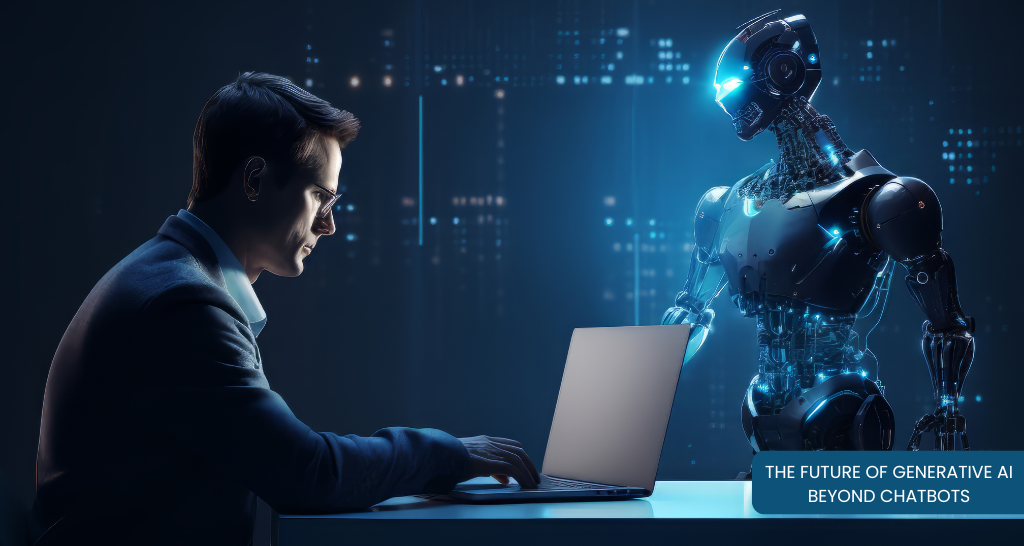
Generative AI has emerged as a transformative technology that extends far beyond the realms of chatbots. Its applications span various fields, delivering innovative solutions in areas such as art generation, music composition, and content creation. Each of these areas is experiencing a surge in generative AI influence, reshaping how creative processes are approached.
In the realm of art, generative AI algorithms enable artists to create unique pieces by analyzing vast datasets of existing artworks. Tools like DALL-E and Artbreeder allow users to generate striking images based on textual descriptions or by blending existing images. This not only enhances creative expression but also democratizes art creation, allowing individuals without traditional skills to produce compelling visual works.
Moreover, music composition is witnessing a similar revolution. Platforms like AIVA and OpenAI’s MuseNet leverage artificial intelligence to compose original music tracks across various genres. These tools analyze thousands of compositions, enabling them to generate new melodies that can be used for everything from film scores to video game soundtracks. This innovation is particularly beneficial for filmmakers and content creators, offering a cost-effective way to access high-quality music without the need for human composers.
Content creation is another significant area where generative AI is making an impact. Businesses are increasingly adopting AI-driven tools for drafting articles, writing marketing copy, and generating social media posts. Tools like GPT-3 facilitate the creation of coherent and contextually relevant content, enabling companies to engage effectively with their audiences. This not only streamlines the writing process but also allows for the production of tailored content that resonates with specific consumer segments.
In summary, generative AI applications are already redefining creative industries, empowering businesses to harness cutting-edge technology for diverse purposes. As these tools evolve, the potential for further innovation continues to expand, paving the way for a future rich with possibilities in art, music, and content generation.
The Role of Generative AI in Creative Fields
Generative AI is poised to revolutionize various creative industries, including music, literature, and the visual arts. By leveraging advanced algorithms, these AI systems can create original compositions, identify artistic styles, and even generate unique narratives, thus providing unprecedented tools for artists and writers. In music, for instance, AI can analyze vast libraries of sounds to produce novel pieces that cater to specific styles, potentially resulting in entirely new genres without human intervention. This augmentation of creativity allows musicians to experiment and explore, thus expanding their artistic horizons.
In literature, AI tools can assist writers through innovative brainstorming, suggesting plot twists, character developments, and stylistic choices. Notably, certain programs are designed to mimic specific authors’ styles, sparking debate over authorship and the creative process’s authenticity. The line between human and machine-generated content becomes increasingly blurred, raising questions about intellectual property and ownership. As an example, who holds the rights to a story crafted collaboratively by an AI and a human writer?
Moreover, visual arts are similarly transformed by generative AI, where tools like GANs (Generative Adversarial Networks) can produce artwork from scratch or significantly alter existing images. Artists are now able to engage with these technologies, employing AI to realize visions that may have been unattainable otherwise. This potential for human-machine collaboration not only stimulates creativity but also prompts a reassessment of what qualifies as art. As artists integrate AI into their workflows, the creative landscape evolves, resulting in hybrid forms that challenge traditional paradigms.
As we move forward, the role of generative AI in creative fields will likely grow, fostering both innovation and discussion surrounding the definition of creativity itself. The implications underscore a shift toward collaborative synthesis between human ingenuity and machine capability, paving the way for future breakthroughs.
Generative AI in Scientific Research
Generative AI is increasingly making its mark in scientific research, proving to be a transformative tool across various disciplines. By leveraging its powerful capabilities, researchers can explore sophisticated methods for drug discovery, climate modeling, and even astrophysics. One notable application is in the pharmaceutical industry, where generative models are employed to predict molecular properties and design novel compounds with desirable characteristics. This AI-driven approach accelerates the identification of potential drug candidates, significantly reducing the time and cost associated with traditional methods.
Moreover, generative AI facilitates the simulation of complex biological systems, enabling scientists to conduct experiments in silico. By generating data that mimics real-world biological interactions, researchers can identify impactful variables and refine their hypotheses without needing extensive lab resources. For instance, generative models have been successfully used to predict how certain compounds will behave in various biological environments, thus providing insights necessary for developing effective treatments.
In climate modeling, generative AI aids in creating predictive models that simulate atmospheric phenomena. Researchers can generate high-fidelity climate scenarios, which allow for assessing the potential impact of climate change over extended periods. This innovative capability assists scientists in generating new hypotheses regarding climate interactions, improving strategies for mitigation and adaptation. Case studies showcase how these models have been employed to reveal previously unconsidered variables affecting climate systems, offering a broader understanding of environmental challenges.
Overall, the integration of generative AI into scientific research signifies a groundbreaking shift. As researchers continue to harness these advanced models, the potential for breakthroughs in various fields expands enormously, changing how hypotheses are generated and validated. Generative AI is not only catalyzing discoveries but also shaping the methodologies through which science itself progresses.
Challenges and Ethical Considerations
The rapid advancement of generative AI technologies brings forth a plethora of challenges and ethical considerations that necessitate urgent attention. One of the most prominent issues is the risk of misinformation. Generative AI systems are capable of producing highly realistic text, audio, and visual content, making it increasingly difficult to distinguish between genuine and fabricated information. This potential for widespread misrepresentation poses significant risks to public discourse, trust in media, and even democratic processes.
Moreover, the emergence of deepfake technology highlights a pressing ethical dilemma. Deepfakes can be utilized to create convincing but false representations of individuals, which can be exploited for malicious purposes such as defamation, fraud, or the manipulation of public opinion. Such capabilities raise serious concerns about consent, as individuals may find their likenesses used in ways they did not approve, leading to broader implications for personal privacy and security.
Another critical area of concern relates to copyright and intellectual property rights. As generative AI systems learn from vast datasets that may include copyrighted material, issues surrounding ownership and attribution of AI-generated content become contentious. Determining whether the output produced by AI warrants copyright protection, and to whom such rights belong, requires careful legal and ethical examination.
Data privacy also remains a significant challenge in the context of generative AI. The collection and processing of vast amounts of personal data to train these systems can lead to potential breaches of privacy, raising questions about user consent and the responsible storage of sensitive information. To address these challenges, it is essential to implement robust regulatory frameworks and establish responsible AI practices that prioritize transparency, accountability, and ethical considerations throughout the technology’s lifecycle.
The Future of Work with Generative AI
As generative AI technologies continue to advance, their integration into the workplace is poised to redefine job roles and functions across various industries. The ability of these systems to create content, analyze data, and automate repetitive tasks means that they could significantly transform workforce dynamics. While there are concerns regarding potential job displacement, particularly in manual and routine tasks, generative AI is also expected to create new roles that focus on innovation, oversight, and ethical application of these technologies.
Companies will need to adapt to these changes by upskilling their employees and fostering a culture of continuous learning. The demand for skills such as data analysis, AI management, and ethical decision-making is anticipated to rise, prompting educational institutions and organizations to redesign training programs. Furthermore, employees who can leverage generative AI tools effectively will likely gain a competitive edge, enhancing their productivity and creativity in problem-solving.
Generative AI can effectively support workers by automating mundane tasks, thus allowing them to focus on higher-level strategic activities that require human insight and empathy. For instance, in fields such as marketing or customer service, employees can rely on AI to generate reports or provide insights from customer interactions. This symbiotic relationship can empower employees to make informed decisions and fosters a more innovative workplace environment.
Despite the potential challenges, the future of work with generative AI holds promise for enhancing efficiency and enabling employees to achieve more. Organizations that embrace this technology will not only contribute to their competitive advantage but also facilitate a smoother transition for their workforce into this new era of digital transformation.
Innovations on the Horizon
The field of generative AI is poised for remarkable advancements, promising to reshape various industries in the coming years. One of the most significant trends anticipated is the evolution of algorithms that power generative models. Researchers are focusing on improving machine learning algorithms to enhance their efficiency and effectiveness. As a result, these algorithms will potentially provide quicker outputs and reduce computational resources, thereby making generative AI accessible to a wider audience.
Furthermore, there will be increased integration of generative AI into existing systems. Companies are beginning to realize the benefits of incorporating generative AI across various domains, such as healthcare, finance, and entertainment. For instance, in the healthcare sector, generative AI could be utilized to analyze data from patient records, enabling personalized treatment plans and more accurate disease prediction. This integration not only increases productivity but also enhances the decision-making process across various sectors.
The role of interdisciplinary collaboration in the development of generative AI cannot be overstated. As advancements occur, teams comprising experts from diverse fields, such as computer science, linguistics, and cognitive psychology, will likely come together to innovate and explore new applications of generative AI technology. This collaborative approach can lead to novel ideas and the creation of more sophisticated, user-friendly AI systems. For example, input from linguistic experts can help refine natural language generation, making interactions with AI far more relatable and efficient.
In conclusion, as we look to the future, we can expect a wealth of innovations in generative AI that will not only enhance existing capabilities but also pave the way for groundbreaking applications across multiple sectors. The next decade holds great promise for the evolution of generative AI, driven by advancements in algorithms, integration into established systems, and interdisciplinary collaboration.
User Experience and Interactivity in Generative AI
The landscape of user experience is undergoing a significant transformation through the application of generative AI technologies. This innovation is particularly evident in interactive domains, such as gaming, virtual reality (VR), and personalized learning environments, where user interaction is pivotal for engagement and satisfaction. Generative AI empowers creators to design dynamic and responsive experiences that adapt in real time to user input, thereby enhancing engagement and satisfaction.
In gaming, for instance, generative AI can create unique narratives and environments, allowing players to experience personalized story arcs based on their choices. Instead of following a linear storyline, players can engage with an evolving game world where the AI responds to their decisions, adjusting challenges and quest lines accordingly. This level of interactivity enhances immersion, as players feel that their actions hold weight and consequence within the virtual space.
Similarly, in virtual reality settings, generative AI can personalize user experiences by tailoring environments and scenarios to individual preferences and behavioral patterns. This can lead to enhanced emotional engagement as users interact with realistic simulations that resonate with their preferences, fostering a deeper connection with the experience.
Moreover, in educational contexts, generative AI can facilitate personalized learning by providing custom-tailored content and feedback based on the learner’s progress and challenges. This dynamic adaptability not only keeps users engaged but also promotes effective learning as the system can modify approaches based on the individual’s needs. The interaction is not just passive; learners actively participate in their education through the feedback loop created by the AI.
Through these various applications, it is clear that generative AI holds the potential to redefine user experience by fostering interactivity that is creative and meaningful, ultimately shaping the future of how individuals engage with digital content.
Conclusion and Call to Action
Throughout this blog post, we have explored the transformative potential of generative AI beyond its current use in chatbots. This technology promises to revolutionize not only how we interact with machines but also how we create, innovate, and solve complex problems across various fields. We examined generative AI’s applications in industries such as healthcare, education, and creative arts, highlighting the collaborative possibilities between humans and intelligent systems.
It is crucial for professionals and stakeholders in all sectors to understand the implications of generative AI. The rise of AI-generated content presents both opportunities and challenges that may redefine existing workflows and business models. As generative AI evolves, so too must our strategies for integration, ethical considerations, and data governance practices. Engaging with this technology means embracing change and innovation, as it holds the potential to enhance productivity and inspire new creative avenues.
We encourage our readers to explore how generative AI can be leveraged within their own workplaces or creative endeavors. This might involve piloting projects that incorporate AI tools, participating in discussions about the ethical dimensions of AI, or contributing to open-source initiatives that advance this technology responsibly. By fostering a mindset of curiosity and collaboration, individuals can play a part in shaping the future of generative AI.
As we stand on the brink of this new technological frontier, the conversation around generative AI must continue to grow. Let us share insights, collaborate, and network to ensure that as this technology progresses, it serves humanity’s best interests. The future of generative AI is not solely in the hands of developers and researchers but also in the hands of each of us as engaged participants in its journey. Let us move forward together with a commitment to exploration and innovation.